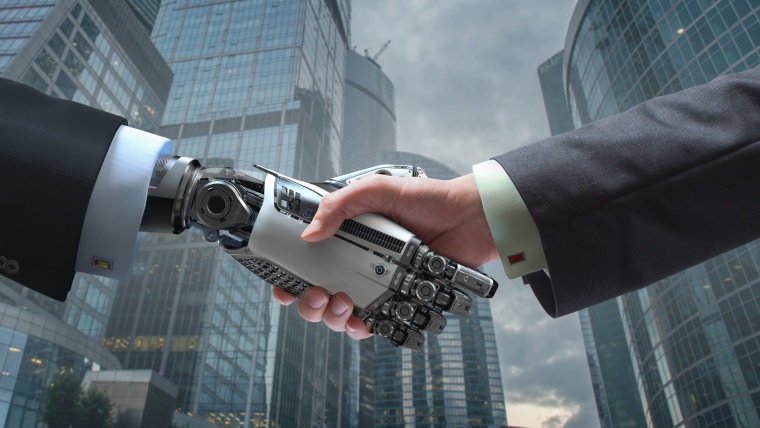
AI is everywhere. Efficiency and trust aren’t there yet
In 2026, the question companies are asking is no longer “whether or not to use AI for translation.” Now the question is where AI is sufficient and where a specialist needs to sign off on the result. Three news stories from this year help answer that question.
1. Most companies still translate manually. DeepL’s “Borderless Business 2026” report, which surveyed executives from the United States, the United Kingdom, France, Germany, and Japan, shows that 35% of international companies still rely on entirely manual translation workflows. Only 17% have adopted tools with language models or AI agents, although 71% of leaders cite the transformation of workflows using AI as a priority for 2026.
2. Europe has begun to require transparency regarding text generated by AI. Effective August 2, 2026, Article 50 of the AI Act requires the identification of AI-generated text published to inform the public about matters of public interest. The exception is text reviewed by a person with editorial control over it. Companies outside the European Union are also subject to this requirement when the content is used there.
3. Even automated quality assessment needs to be evaluated. AMTA, the Association for Machine Translation in the Americas, created a working group to standardize how to measure tools that estimate translation quality of AI-generated translations. The results were presented at the organization’s conference, held from August 31 to September 2, 2026. The reason: today, each vendor uses its own method of measurement, making it impossible for buyers to compare them.
How does this affect those who translate manuals, contracts, and official documents?
All three news stories point to the same conclusion: AI speeds up the process, but responsibility for the final text still lies with a person. In Brazil, this responsibility is already mandated by law for various documents.
- Machinery and equipment manuals: NR-12 (item 12.13.2) requires manuals written in Brazilian Portuguese that are clear, unambiguous, and feature safety warnings that are clearly highlighted. A terminology error in a warning creates a risk of an accident and a regulatory citation.
- Products sold to consumers: The Brazilian Consumer Protection Code – CDC (Art. 31) requires that information be correct, clear, precise, and provided in Portuguese. This applies to owner’s manuals for cars, motorcycles, and household appliances.
- Official documents: Notary offices, commercial registries, and government agencies require a sworn translation prepared and signed by a licensed public translator. No AI can replace that signature.
- Content published in Europe: Under the AI Act, informational text generated by AI without human review must be identified as such. Professional review prevents this label and mitigates reputational risk.
When AI is enough and when human review is required
The rule of thumb is to consider the cost of a mistake. The greater the legal, safety, or reputational risk, the more the text needs to be reviewed by an expert at the end of the process.
|
Content type |
Risk of a mistake |
Recommended approach |
|
Internal emails, drafts, research |
Low |
AI with a quick review by the requester |
|
Website, catalog, marketing materials |
Medium: brand image |
AI + professional post-editing (ISO 18587) + cultural adaptation |
|
Owner’s manual and instruction manual |
High: safety and CDC |
Technical translation with a glossary, human review, and layout faithful to the original |
|
Machine manuals (NR-12), safety data sheets |
High: accidents and regulatory citations |
Technical translator specializing in the industry, review, and terminology validation |
|
Contracts, regulatory documents (ANVISA, 20-F) |
High: legal and financial |
Specialized translator + reviewer, with no publication of raw AI output |
|
Certificates, diplomas, documents for notary offices |
Mandatory by law |
Sworn translation, signed by a public translator |
A word of caution: if the text is going to be signed, published, or used by someone operating a machine, it should not go directly from the AI to the client.
How Global Languages combines AI and experts
Since 1992, Global Languages has been providing technical and sworn translations for the automotive, motorcycle, machinery and equipment, energy, healthcare, and legal industries. We use AI where it speeds up the process, always with a specialist translator reviewing the final product.
- Document analysis: we determine the risk level and the appropriate workflow, from post-editing to sworn translation.
- Client terminology: a glossary and translation memory ensure consistent terminology across all manuals.
- Translation and human review: AI-generated text with post-editing in accordance with ISO 18587, or a full translation by a specialist, as appropriate.
- Layout: the file is returned in the original layout, in InDesign or Illustrator, ready to print.
- Delivery and confidentiality: agreed deadlines and secure handling of your files.
Need to translate manuals, contracts or official documents? Request a quote or talk to us on WhatsApp:

Frequently asked questions
Is an AI-generated translation valid for use at a notary’s office or government agency? No. Documents with official status require a sworn translation, prepared and signed by a licensed public translator.
What is post-editing of machine translation? It is the revision, by a professional translator, of a text translated by a machine. The ISO 18587 standard defines how this work should be done to achieve the quality of a human translation.
Can I use AI to translate my product manual? You can use it as part of the process, but the final text needs to be technically reviewed. The manual must be accurate and clear in Portuguese (CDC, Art. 31) and, in the case of machinery, comply with NR-12.
Does using AI make translation cheaper? For low- and medium-risk content, post-editing typically reduces turnaround time and cost. For critical documents, the savings come from avoiding rework, recalls of printed material, and legal issues.
Are my documents secure? At Global Languages,