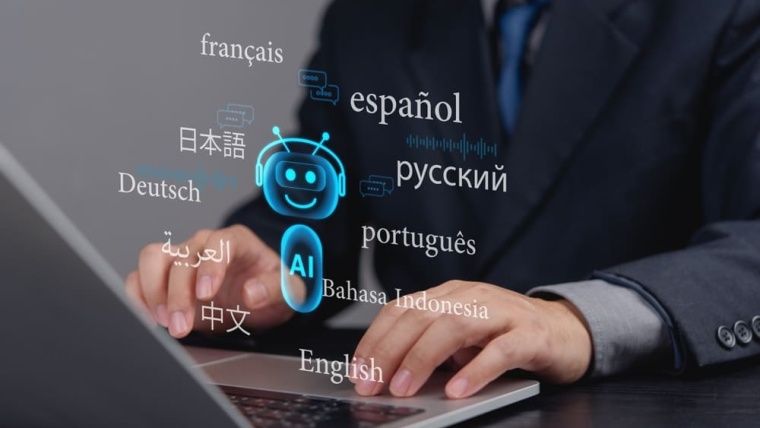
Artificial Intelligence has stopped being a trend and become a reality in the translation market. In recent years, advances in neural translation models and large language models have transformed the way companies produce multilingual content, delivering significant productivity gains, lower costs and faster turnaround.
But this evolution raises a common question: will Artificial Intelligence replace translators?
The answer is more complex than a simple “yes” or “no.”
In practice, AI has become a powerful ally for companies and language professionals. However, when it comes to technical, legal, medical, financial or regulatory documents, human review remains essential to ensure accuracy, safety and reliability.
In this article, we explain when Artificial Intelligence is the best choice, when human involvement is essential, and how companies can combine technology and specialized expertise to achieve the best results.
How Artificial Intelligence Is Transforming the Translation Market
Translation tools have evolved significantly over the past decade. Unlike older machine translation systems, which often produced literal, unnatural text, today’s systems can understand complex linguistic structures, recognize patterns and generate far more fluent translations.
In addition, specialized companies use these technologies integrated with professional platforms, translation memories, technical glossaries and automated quality control systems.
This combination significantly reduces project turnaround time while maintaining terminology consistency and increasing productivity.
For companies that need to translate thousands of pages per year, this evolution represents a major competitive advantage.
When Artificial Intelligence Delivers Excellent Results
There are several types of content where AI performs extremely well, especially when the goal is to accelerate large volumes of information.
These include:
- Manuals with repetitive content;
- Product catalogs;
- Internal documentation;
- Knowledge bases;
- Customer support content;
- Technical documentation updates;
- Frequently asked questions (FAQs);
- Previously standardized content.
When paired with Translation Memories and corporate glossaries, AI can reuse previously approved translations, ensuring greater consistency across different versions of the content.
The result is a combination of speed, consistency and cost reduction.
When Human Review Remains Essential
Despite technological advances, there are situations where machine translation still shows important limitations.
Documents involving legal liability, regulatory requirements, technical information or financial impact require specialized analysis.
These include:
- Contracts;
- Patents;
- Legal documentation;
- Clinical studies;
- Pharmaceutical documentation;
- Financial reports;
- Technical standards;
- Operating procedures;
- Industrial equipment manuals;
- Documentation for international certifications.
In these cases, a single inappropriate terminology choice can completely change the meaning of a document, cause delays in regulatory processes, or even compromise operational safety.
This is precisely the scenario where the expertise of a specialized translator makes all the difference.
AI Understands Words. Specialists Understand Context.
One of the main limitations of Artificial Intelligence is still fully understanding business context.
The same word can take on completely different meanings depending on the industry.
Likewise, terms used in the medical, pharmaceutical, legal, financial and technology fields require specific technical knowledge that goes far beyond literal translation.
The role of the specialized translator is to interpret context, understand the purpose of the document, and ensure that the terminology used is appropriate to the client’s industry.
The Most Effective Model: Artificial Intelligence + Human Review
The most innovative companies already understand that the future of translation does not lie in replacing the professional with technology.
The market is moving toward a hybrid model.
In this model, Artificial Intelligence produces a first draft of the translation, while specialists carry out Post-Editing (Machine Translation Post-Editing, or MTPE), reviewing terminology, context, style and technical accuracy.
This approach offers several benefits:
- significant reduction in delivery times;
- cost optimization on large-volume projects;
- terminology standardization;
- greater consistency across documents;
- quality that meets corporate requirements;
- reduced risk of misinterpretation.
Technology accelerates the process.
Human expertise ensures the quality.
Information Security Is Also Part of Quality
Another aspect that is often overlooked is document confidentiality.
Not every public Artificial Intelligence platform offers adequate safeguards for corporate content.
Projects involving intellectual property, research, engineering, contracts, strategic information or confidential documentation require secure environments, confidentiality agreements and structured processes.
When choosing a specialized partner, companies are not just hiring a translation.
They are gaining security, traceability, confidentiality and compliance with their internal policies.
The Future of Translation Is Collaborative
The debate is no longer “Artificial Intelligence versus translator.”
The most competitive organizations already understand that combining technology with human expertise produces superior results.
Artificial Intelligence offers speed.
Specialized translators offer experience, critical analysis, cultural adaptation, technical knowledge and accountability for the content delivered.
It is this combination that is shaping the future of the translation market.
Keep Following Our Content
Digital transformation is rapidly changing the way companies manage their translation, localization and global communication processes.
That’s why Global Languages is preparing a series of articles that take a deeper look at the key topics affecting organizations with an international footprint.
Why Choose Global Languages?
For more than 30 years, Global Languages has supported national and multinational companies in overcoming language barriers, offering complete solutions in translation, content localization, interpreting, subtitling, dubbing, multilingual desktop publishing and language consulting.
Our team serves organizations in the industrial, automotive, pharmaceutical, technology, energy, financial, legal, infrastructure and manufacturing sectors, always with a focus on quality, agility and confidentiality.
We use the market’s leading technologies, including Artificial Intelligence, Translation Memories, technical glossaries, professional platforms and rigorous quality control processes, without ever giving up review by specialists when accuracy is essential.
This combination reduces turnaround times, optimizes costs and maintains the technical excellence required by companies operating in national and international markets.
Regardless of project volume or complexity, we develop customized solutions to ensure that every translation preserves not only the meaning of the words, but also the context, terminology and strategic goals of the client.
Talk to Global Languages
If your company is looking for a partner capable of combining technology, experience and quality to support your global communication, Global Languages is ready to help.
Contact our team and discover how we can make your multilingual projects faster, safer, more consistent and more efficient.
Global Languages. Technology when it adds value. Specialists when accuracy makes the difference.